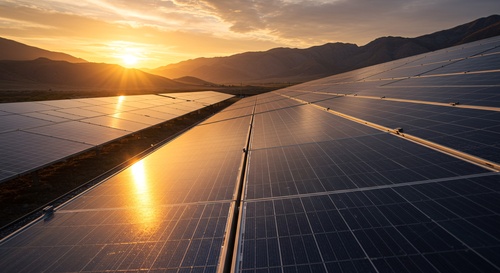
The Middle East is undergoing a profound transformation of its energy landscape. Once almost fully reliant on fossil fuels, the region is now positioning solar power at the center of its diversification and sustainability agenda. Solar energy still represents only about 2% of the regional energy mix compared to 87% for fossil fuels, yet growth has been remarkable.
According to MESIA’s Solar Outlook Report 2025, installed solar capacity expanded by 23% in 2023 to reach 32 GWp and is projected to exceed 40 GWp by the end of 2024. By 2030, the region could reach 180 GWp, marking one of the world’s fastest clean energy transitions.
Driven by declining costs, competitive auctions, and ambitious policy targets, the Middle East’s solar market is expanding rapidly. Wood Mackenzie forecasts that regional capacity will surpass 100 GW by 2029, which would be an 800% increase within a decade. In 2024, United Arab Emirates (UAE) lead installations in the region with 6.52 GW, followed by Saudi Arabia (5.69 GW), Israel (5.85 GW), Egypt (3.41 GW), and Jordan (1.96 GW). The UAE’s Energy Strategy 2050 and Saudi Arabia’s accelerated National Renewable Energy Program are setting the tone for large-scale adoption, with Saudi Arabia tendering over 10 GW of solar projects in 2024 alone.
The Middle East’s exceptional solar irradiation and competitive levelized cost of electricity—already below USD 20/MWh in recent tenders make PV among the most attractive generation options. Still, several challenges persist. Grid connection bottlenecks and transmission capacity constraints delay project completion, especially in fast-growing markets like the UAE and Saudi Arabia. Regulatory complexity and lengthy permitting processes remain hurdles for developers. Moreover, fossil fuel subsidies continue to slow the competitiveness of solar power, while the local manufacturing base is still in its early stages.
Utility-scale solar remains dominant, accounting for more than 85% of new capacity additions through 2030 according to Wood Mackenzie. However, distributed generation is accelerating. According to MESIA, commercial and industrial (C&I) installations across the Gulf Cooperation Council (GCC) countries (UAE, Saudi Arabia, Qatar, Oman, Kuwait, and Bahrain) grew by over 20% in 2024. Residential systems, driven by Dubai’s Shams initiative, are approaching 500 MW of cumulative capacity. New applications, such as floating PV in Oman, are emerging. Meanwhile, business models for producing large quantities of green hydrogen are giving the PV market a boost.
The Mohammed Bin Rashid Al Maktoum Solar Park in UAE is is among the largest single-site solar installations globally. While it is projected to reach its full capacity of 5 GW by the end of this decade, the current operational capacity of over 2.6 GW already positions it as one of the largest solar projects in the Middle East, and the world, with total investments amounting to AED 50 billion. [SH1] The project combines PV with the concentrated solar power (CSP) technology.
The two plants of Shuaibah Two Solar Facility in Saudi Arabia, developed by a joint venture between ACWA Power and Badeel, have a combined capacity of 2.6 GW. According to ACWA Power’s third-quarter report, the total investment for the two projects is SAR 8.25 billion (USD 2.2 billion / EUR 2.08 billion). Both plants are expected to be fully operational by the end of 2025. The two solar facilities are expected to contribute around 50% of the Saudi Arab energy mix by 2030.
The Al Dhafra Solar PV plant in UAE, developed by a consortium including EDF Renewables, Jinko Power, Abu Dhabi Future Energy Company (Masdar), and Abu Dhabi National Energy Company (TAQA), has a generating capacity of 2 GW. The investment volume of the project was around USD 1 billion.